
|
May 15, 2026 Newsletter 250 |
|---|---|
Market Highlight |
|---|
|
Bond Market In the U.S. bond market, the U.S. March manufacturing purchasing managers index (PMI) reported on April 1 by The Institute for Supply Management (ISM) rose to 52.7, slightly higher than previous month’s level of 52.4 and market expectations of 52.3. According to the March non-farm payroll and unemployment statistics released by the Bureau of Labor Statistics on April 3, around 178,000 more non-farm jobs were created in March, higher than the market expectation of 65,000 jobs; the February number were revised downward from -92,000 jobs to -133,000 jobs; and the unemployment rate in March decreased to 4.3% from 4.4% in February. It was also marginally lower than the anticipated level of 4.4%. The March Consumer Price Index (CPI) published by the Bureau of Labor Statistics on April 10 increased 3.3% year-over-year, slightly lower to that of the market expectation of 3.4% and higher than the preceding month (2.4%). The core CPI rose to 2.6% year-on-year in March, slightly lower than the market expectation of 2.7%. The growth rate of the previous month was 2.5%. On April 29, the Federal Reserve (Fed) decided by a vote of 8 to 4 to maintain the federal funds rate in the range of 3.50% to 3.75%, marking the first time since October 1992 that four officials have voted against a monetary policy decision. Apart from Miran, who was also the chairman of the Council of Economic Advisers in the White House and kept advocating for a further 25 basis point rate cut at this meeting, three Fed presidents (namely Hammack, Kashkari, and Logan), while agreeing to keep the interest rate unchanged, suggested that the dovish tendency of preferring rate cuts over rate hikes persistently evident in the comments over the last two years was no longer appropriate, indicating a divergence of opinions among Fed policymakers. The Federal Reserve revised its description of inflation in this statement, emphasizing that the recent rise in inflation was the result of surges in global energy prices, admitting the fact that “developments in the Middle East have significantly increased uncertainty around economic outlook.” At the press conference, Fed Chairman Jerome Powell reiterated that the committee is not currently considering any rate hike, but the “focus” was shifting toward more neutral wording applied in the official statement. In April, US Treasury yields stayed rangebound, with the 10-year yield fluctuating between 4.20% and 4.45%, lacking a clear direction overall. As of April 30, the yield on the 10-year U.S. Treasury note closed at 4.371%, up 5.4 basis points from the level at the end of March (4.317%).
Major stock exchanges in the world, such as Stockholm Stock Exchange, London Stock Exchange, Luxembourg Stock Exchange, Euronext, Korea Exchange, Hong Kong Exchange, and Singapore Exchange have set up a special board for the trading of sustainable bond, economic, social, and governance (ESG) bond or socially responsible investment (SRI) bond. In a move to promote Taiwan's sustainable finance, continue to keep abreast of international markets and enhance the international visibility of our capital market, and in support of the Corporate Governance 3.0 – Sustainable Development Roadmap, Green Finance Action Plan 3.0 as well as Capital Market Roadmap 2021–2023 promoted by the competent authorities, Taipei Exchange (TPEx), in reference of international trends, integrated the green bond listing and trading mechanism, social bond listing and trading mechanism, and sustainability bond listing and trading mechanism into the sustainable bond listing and trading mechanism and has set up a Sustainable Bond Board. On top of the capital bonds dedicated to sustainable developments, in order to assist enterprises achieve their overall strategic sustainable development goals, work toward net zero emissions and sustainable transformations, as well as to expand the range of sustainable bonds offered in Taiwan, the TPEx has promulgated the Sustainability-Linked Bond (SLB) trading system on July 8, 2022 so as to offer even more diversified sustainable fund-raising and investment tools, as well as to keep abreast of international markets for issuers and investors at home and abroad. Furthermore, to provide the market with well-rounded information and contents on sustainable bonds, the TPEx has formulated a dedicated Sustainable Bond website (https://www.tpex.org.tw/web/bond/sustainability/index.php?l=zh-tw). On top of relevant information such as Taiwan's progress in developing sustainable bonds over the years, summaries on the bonds, overviews on bond issuance (e.g., issuing criteria, issuance plan and post-market report), latest information, and research reports, the website also aims to actively strengthen ESG information disclosure on the bond issuers. "Issuer's Sustainable Development Strategies" and "Sustainable Bond Benefits" sections have been added to the website since 2022. The convenient and user-friendly interface is designed to provide market participants with comprehensive and enriched reference information, thereby allowing them to understand the latest development trends and directions in the sustainable bond market both at home and abroad. |
|
TPEx Treasury Yield Curve 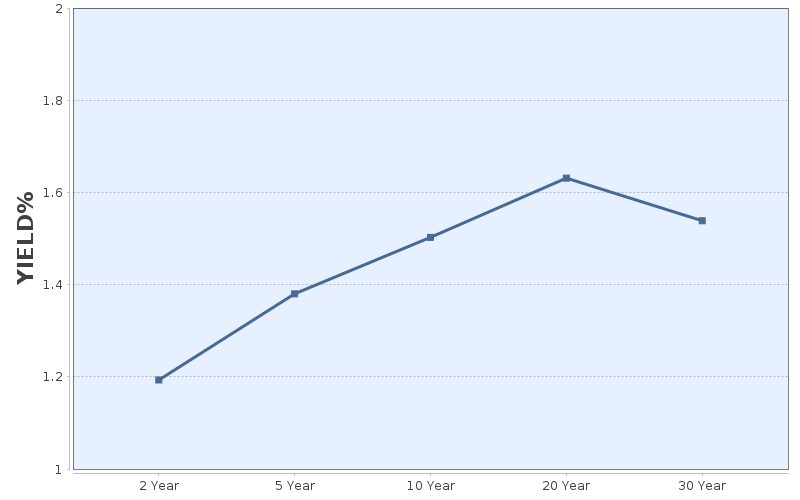
2026 April
|
|
15F., No.100, Sec. 2, Roosevelt Rd., Taipei City 100, Taiwan (R.O.C.) Tel : 886-02-2369-9555 For more information please visit our website : https://www.tpex.org.tw/en-us/index.html |